.webp)




Are you accepting blind spots in your pipeline because your sales calls are not captured and analyzed? This guide covers the tools that turn unstructured conversations into concrete revenue data, the features that separate the best from the rest, and the compliance basics you need to record legally.
The bottom line: sales call recording has evolved from passive storage into active conversation intelligence. By automating data entry and extracting actionable insights, it helps turn your CRM into a more reliable source of truth, supporting accurate forecasting and efficient coaching without adding platform fatigue.
Why sales call recording is no longer optional
From simple recording to conversation intelligence
Call recording is no longer about keeping audio files in a folder you never reopen. Today it is about analyzing real performance data to improve. This is where conversation intelligence comes in: AI breaks down each interaction to extract actionable insights and structured data, so you can access the voice of the customer without manual filtering, turning vague conversation into concrete business assets. Companies that ignore this shift leave value on the table every day by relying on guesswork.
Improve your sales coaching and onboarding
Coaching on gut feeling alone is fading. Managers can now rely on facts from actual calls, seeing what converts and what loses the deal. Onboarding benefits too: new hires listen to recordings from top performers to learn what good looks like, which speeds up their ramp and gets them quota-ready faster. Recorded calls are a valuable resource for training and coaching, because evidence beats opinion.
Get real visibility into your pipeline and forecasts
Many CRMs are full of incomplete or biased data, which makes forecasts unreliable. Conversation intelligence tools help by capturing budget, timeline, and competitor information directly from the source, so your CRM data becomes more reliable and structured automatically. Tools like Praiz do this with GDPR compliance in mind. Recording sales calls is not about monitoring your team, it is about giving leaders a clearer view of reality to make better, data-driven decisions.
Key features that separate the best from the rest
AI-powered analysis and transcription
Automatic transcription is the baseline, and you want high accuracy across languages so reps can focus fully on the conversation instead of taking notes. The real value, though, is in granular AI analysis: detecting buying signals, flagging risks, and analyzing sentiment shifts. Good tools go beyond text to identify action items and the talk-to-listen ratio, which are concrete metrics you can act on. Conversation intelligence provides insights that help you guide teams with more precision.
Seamless CRM integration is non-negotiable
A recording tool that does not connect cleanly to your CRM is a gadget, not a strategic lever. It should feed the CRM automatically, whether you use Salesforce or HubSpot, freeing reps from manual CRM updates. The tool should push key data, next steps, and contacts into the correct fields without manual work, which turns conversations into usable data for forecasts. Broad integration is a real advantage for accurate reporting.
Customization for your specific business needs
Every business is different: your KPIs, your sales methodologies such as MEDDIC, and your common objections are specific to you. The best tools allow advanced customization through custom prompts, so you can configure the AI to extract exactly what matters in your vertical rather than generic summaries. Compliance matters too, so look for features that help you respect GDPR. A rigid one-size-fits-all tool tends to produce average results, so look for flexibility that aligns with your strategy.
A look at the top sales call recording tools in 2026
The main players: a quick overview
The market is crowded. Heavyweights like Gong and Modjo build their own analysis ecosystem, which means adopting another platform alongside your CRM. Others, like Claap, focus on recording and smart summaries with an emphasis on video collaboration. Otter remains a solid choice for audio-first needs, prioritizing transcription speed over visual context. A different approach is to enrich the CRM you already use rather than adding a separate platform, which is the angle Praiz takes.
Feature comparison of leading solutions
A direct comparison helps. The table below focuses on criteria that affect your team's daily performance and data quality. Full disclosure: Praiz is our platform, so weigh it on the same terms as the others.
| Criterion | Claap | Otter | Outreach | Praiz |
|---|---|---|---|---|
| Core philosophy | Collaborative video hub | AI meeting assistant | Sales engagement | Conversation intelligence and CRM automation |
| AI analysis | Summaries and items | Summaries | Basic intelligence | Custom templates |
| CRM integration | Limited | Limited | Native | Broad |
| Main use case | Sharing highlights | Transcription | Sales cadence | CRM automation |
| Video | Yes | No | Limited | Yes |
| Pricing | Freemium | Freemium | High per seat | Subscription |
Praiz: an AI layer that enriches your CRM
Full disclosure, Praiz is our platform. Most tools ask you to adopt a new platform; Praiz takes the opposite approach and improves the one you already use every day.
Stop adding platforms, enhance your CRM instead
Tool fatigue is real. Reps already spend their days across the CRM, messaging apps, and video tools. The idea behind Praiz is not to be another platform, but to work in the background and help make the CRM the single source of truth, so you get more reliable, complete data and maximize the ROI of the tools you already pay for.
Broad integration: connect your stack
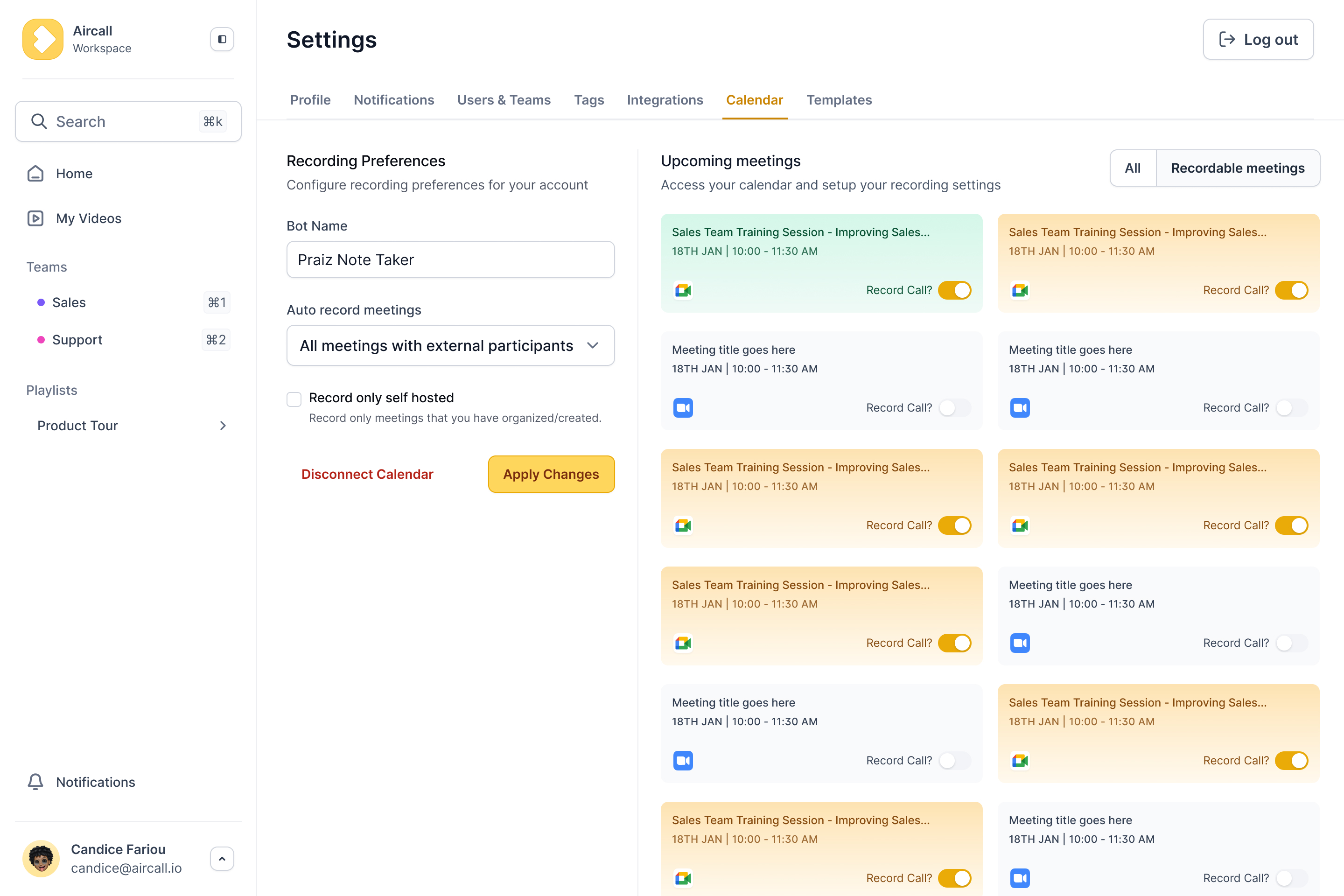
Whether your team uses Zoom, Teams, Aircall, or a custom CRM, Praiz is built around a robust API and works with major CRMs and with VoIP or video call sources. That flexibility matters to IT leaders looking for scalable sales enablement solutions that fit their environment rather than forcing a change of stack.
Built by people who know sales
Technology helps, but understanding the field matters too. The team behind Praiz comes from a sales and telephony background, including experience at Aircall, so they know the day-to-day pains of reps and managers. It is a sales-driven product designed to solve real revenue problems rather than a tool built by guessing at what sales teams need.
Specialized AI agents, not just recordings
Praiz runs three families of AI agents on every conversation: generation (summaries, follow-up emails, proposals), scoring (call evaluation against MEDDIC, BANT, or your own grid), and tracking (competitor mentions, recurring objections, product feedback). The structured output syncs into your CRM fields and can be queried from Claude or ChatGPT through a native MCP server. The measured impact (internal Praiz data): CRM completion multiplied by 5, about 1h30 saved per rep per day, and 100% of calls scored. Hands-on onboarding and agent configuration are included rather than left to your team, which most vendors do not offer.
See it in action
Stop logging calls. Start mining them.
Praiz extracts the data hidden in your customer conversations and pushes it straight to your CRM.
Staying compliant: the legal side of recording sales calls
Adopting a strong tool helps, but using it legally is essential. This is general guidance, not legal advice, so confirm the rules for your regions with your legal team or DPO.
Understanding consent: one-party vs all-party
The core rule is consent, and the law shifts depending on where you call. In one-party jurisdictions, only one person on the line needs to be aware, and that can be you. Other regions enforce all-party rules, meaning everyone must agree to the recording. To stay safe and transparent, a common practice is to treat every call as if it were an all-party scenario.
GDPR and what it means for your sales calls
If you sell in Europe, GDPR sets the standard, and it is strict about how you collect and handle personal data. You need a clear legal basis, usually consent, before recording, and you must inform people of their rights and secure that data. Falling short can expose you to significant fines. Choose tools like Praiz that take regulatory compliance seriously.
Practical tips for getting consent
You can get consent without disrupting the conversation by being direct and transparent. Three ways to announce a recording:
- The direct approach: "Just so you know, I'm recording this call for quality and training purposes. Is that okay with you?"
- The benefit-driven approach: "So I don't miss any important details and can focus on our conversation, I'd like to record this call. Does that work for you?"
- The automated notice: many platforms like Zoom or Teams can display an automatic recording notification, which handles the formal part for you.
Real-world applications: where call recording makes a difference
Theory is fine, but where do these tools actually move the needle on revenue?
High-volume, high-velocity: SaaS and tech
In SaaS and tech, call volume is high and sales cycles are short, so every conversation counts toward quota and you cannot afford to lose data. Here, a sales call recorder saves time on admin, analyzes large numbers of calls to find conversion patterns, and helps improve scripts continuously, which adds up to a faster, smarter sales engine.
Optimizing scripts and quality in call centers
For call centers, standardization and quality are the priorities, and turnover is often high, which makes consistency a daily challenge. Recording and analysis let you check that scripts are followed, identify the best qualification practices, and highlight the closing techniques that work. It becomes a useful quality-management tool that brings order to high-volume environments.
Who benefits most? a look at the ideal user
The impact spans the whole revenue organization. Key beneficiaries include:
- Sales leaders (VP Sales, CROs): for performance tracking, pipeline visibility, and standardizing best practices across larger teams.
- Heads of sales at startups and scale-ups: to implement a modern, tech-driven sales process and maximize efficiency with a small, growing team.
- Sales reps and CSMs: to reduce manual note-taking, improve their own performance, and focus on selling and helping customers.
Call recording software for enterprise teams
Larger organizations should add a few criteria to the comparison above. Security reviews go faster when the vendor offers SSO, granular admin controls, and clear data retention policies, and legal teams will ask where recordings are stored and how consent is captured across regions. Check how pricing scales past fifty seats: per-seat models with AI usage caps can double the bill as adoption grows, while flat pricing keeps costs predictable. Finally, weigh the rollout: enterprise deployments live or die on onboarding and configuration support, so ask each vendor what help they actually provide. If you are still building the internal case, our guide on the benefits of sales call recording covers the arguments that convince leadership.
Sales call recording has moved from simple storage to a core engine for revenue intelligence. Whether you choose a standalone platform or a CRM-integrated approach like Praiz, the objective is the same: reliable data and scalable coaching. Stop guessing, and give your team the visibility they need to close more deals.
Frequently Asked Questions
Can I actually record my sales calls legally?
Yes, and from a revenue intelligence perspective, you generally should, but the legality depends on where you and your prospect are located. In the US, federal law permits recording if one party consents, which can be you, though state laws vary significantly. In Europe, GDPR rules are strict and usually require explicit consent.
To stay safe and scalable, the best practice for sales teams is to treat every call as if it requires full consent, and a tool like Praiz helps you capture CRM data while respecting compliance.
Is recording a call without consent ever legal?
It depends on the jurisdiction. In one-party consent jurisdictions, including US federal law and many states, it is legal to record as long as you are part of the conversation, and you do not strictly need the other person's permission.
However, in all-party consent states or under GDPR in Europe, recording without the other person's knowledge is illegal and can lead to severe penalties. For a sales leader, relying on that loophole is risky, and transparency is the better policy for building trust.
Which states require two-party consent for recording?
While most US states follow the one-party rule, roughly a dozen require all-party or two-party consent. These generally include California, Florida, Illinois, Maryland, Massachusetts, Montana, Nevada, New Hampshire, Pennsylvania, and Washington.
Since reps often call across state lines, tracking individual rules is difficult, so the most efficient strategy is a blanket policy of getting consent on every call.
Do I legally have to announce that the call is being recorded?
In all-party consent states and GDPR zones, yes, you must announce it before recording begins, since failing to do so can make the recording illegal and inadmissible.
In one-party states you might not be legally required to, but doing so remains a best practice. Many recording tools automate this through audio notifications or visual cues, which keeps you compliant without adding friction for your reps.