A sales demo exists to let a buyer verify one claim they already half believe. Not to tour the product, not to prove it is comprehensive, not to impress. One claim, checked against their own situation, so they can stop wondering whether it would work for them.
That framing decides everything else: what you show, what you cut, and how long it takes. And it explains the most common failure, which is not a presentation problem at all.
The bottom line: a demo that shows everything proves nothing, so pick the one claim this buyer needs verified, show the shortest path to it and stop. Which claim that is was decided in the discovery call, which is why a generic demo is a discovery failure rather than a presentation failure: a rep with nothing specific to aim at ends up showing the product in menu order. Demos are also the longest call in the cycle and the least reviewed, which is how the same habit survives in a team for years.
What a sales demo is for
Three jobs, in order of how often they get confused.
Verifying a claim. In discovery you said something like "teams usually stop rebuilding the plan by hand". The demo is where they check whether that is true for a situation like theirs. If they leave convinced of that one thing, the demo worked.
Removing a specific doubt. Usually unstated, usually technical, usually about their own context: our data is messier, our process is different, our team will not adopt it. The demo is the cheapest place to settle it.
Giving the champion something to repeat. Most demos are retold internally by someone who was there to someone who was not. If your demo cannot be summarised in two sentences by a non-expert, it will not survive that retelling.
What a demo is not: a training session, a feature inventory, or a substitute for qualification. If you are demoing to find out whether they have a problem, you skipped a step and the right fix is a discovery call.
The demo is decided in the discovery call
This is the part most demo advice skips, and it is where the outcome is actually set.
A demo can only verify a claim if you know which claim matters. That comes from the previous conversation: what they are trying to fix, what they tried before, who else has to be convinced, what would make them say no. Without those four, you have nothing to aim at, so you show the product in the order the product menu happens to be in.
Which is exactly what a generic demo is. Not a rep who presents badly: a rep who was never given anything specific to present. The patterns in qualifying questions are what make a demo possible, and the test is simple.
Before the demo, write one sentence: "By the end, Marie should be convinced that ___". If you cannot fill the blank with something specific to her, do not run the demo. Run another discovery call instead, and say so plainly. A postponed demo costs you a week; a generic demo costs you the deal and you will not know why.
The five parts of a demo that earns a next step
1. The recap, in ninety seconds
Open by stating back what you understood, and ask them to correct it. "Last time you said the plan gets rebuilt every Friday and that your team lead spends half a day on it. Still accurate? Anything changed?"
Two things happen. You find out whether something moved since last time, which it often has. And anyone new on the call gets the context without you explaining your product first.
2. The claim, stated out loud
Say what you are about to prove, in one sentence, before you share your screen. "I want to show you one thing: that the Friday rebuild stops being a manual job. If that lands, we can talk about the rest."
This feels reductive and it is the opposite. It gives the demo a success criterion, which means the buyer can tell whether it worked rather than politely saying it looked great.
3. The path, with their data if possible
Then show the shortest route from their problem to the result, using their vocabulary and, where you can, their own data or a close approximation of it.
A demo on invented sample data asks the buyer to do the translation work themselves, and plenty of them will not bother. HubSpot's piece on sales demo environments is useful here: a properly set-up environment with realistic data is worth more than a slicker presentation.
4. The pause
Stop after the path and say nothing. Three seconds, properly uncomfortable.
This is the single highest-value moment in the call and the one reps skip most. The silence is where the real objection arrives, and the real objection is the one you need. Fill it with "any questions so far?" and you get "no, looks good", which tells you nothing.
5. The next step, named before you hang up
A specific, dated, small next action with an owner. "I'll send the recap today. Can we get your IT lead on a call Thursday?"
If no next step is agreed, the demo did not work, whatever the mood in the room was. And the recap goes out the same day, because the person who has to retell this internally needs something to retell it from.
What to cut from your sales demo
Most demos are twice as long as they need to be. Five things to remove, in order of how little they contribute.
| Cut this | Why it is there | What to do instead |
|---|---|---|
| The company story | It is in the deck and nobody removed it | One sentence, or nothing |
| The dashboard tour | It demos well and proves nothing | Show it only if a reporting gap was named in discovery |
| Admin and settings screens | The rep knows them best | Keep for the technical call, after the decision |
| The integrations list | Fear that theirs is missing | Name their two and move on |
| Features nobody asked about | Wanting to show value for money | Mention one in a sentence, do not open it |
The rule that makes this easy: if a screen does not help verify the claim you stated in part two, it does not belong in this demo. It might belong in the next one.
For a wider view of the conventional advice, HubSpot's guide to product demos and Salesforce's take on memorable demos both cover the presentation craft well. The part they underweight is how much of the outcome was already fixed before the call started.
The mistakes that cost the deal
Four, and the last one is the expensive one.
Talking more than showing. A rep narrating their own screen for twenty minutes has turned a demo into a webinar. Aim for the buyer talking a third of the time, and count it if you are not sure.
Demoing to the wrong room. If the person who signs is not there and nobody has asked who they are, the demo is a rehearsal. Worth checking before you prepare, not after.
Answering a feature question with a feature answer. "Does it do X?" usually means "I have a problem X would solve". Answering yes and moving on wastes the only moment they told you what worries them.
Treating the polite demo as a good demo. The most dangerous outcome is the call where everything went smoothly, everyone was complimentary, and nobody committed to anything. That deal is already lost and it will sit in your pipeline for two quarters. The objections that kill deals are rarely stated, and a demo that produced no friction produced no information.
How to tell whether your demos are working
Three numbers, and one of them is uncomfortable.
- Demo to next-step rate. The share of demos that end with a dated commitment. Not a verbal "we'll come back to you": a date in a calendar. Under half means the problem is upstream, in discovery.
- Talk ratio. How much of the call was the rep. Over two thirds and you are presenting rather than demoing.
- Economic buyer attendance. The share of demos where the person who can sign was in the room. This is the number nobody wants to look at, and it predicts the forecast better than anything else on the list.
If the demo-to-next-step rate is low while discovery looks healthy, that is an execution problem and it has a specific diagnosis.
Where Praiz fits in
Here is the structural problem with improving demos. They are the longest call in the cycle, often an hour, and there are more of them than any manager can watch. So demos end up being the least reviewed call type in the entire process, which is why a bad habit can survive in a team for two years without anyone naming it.
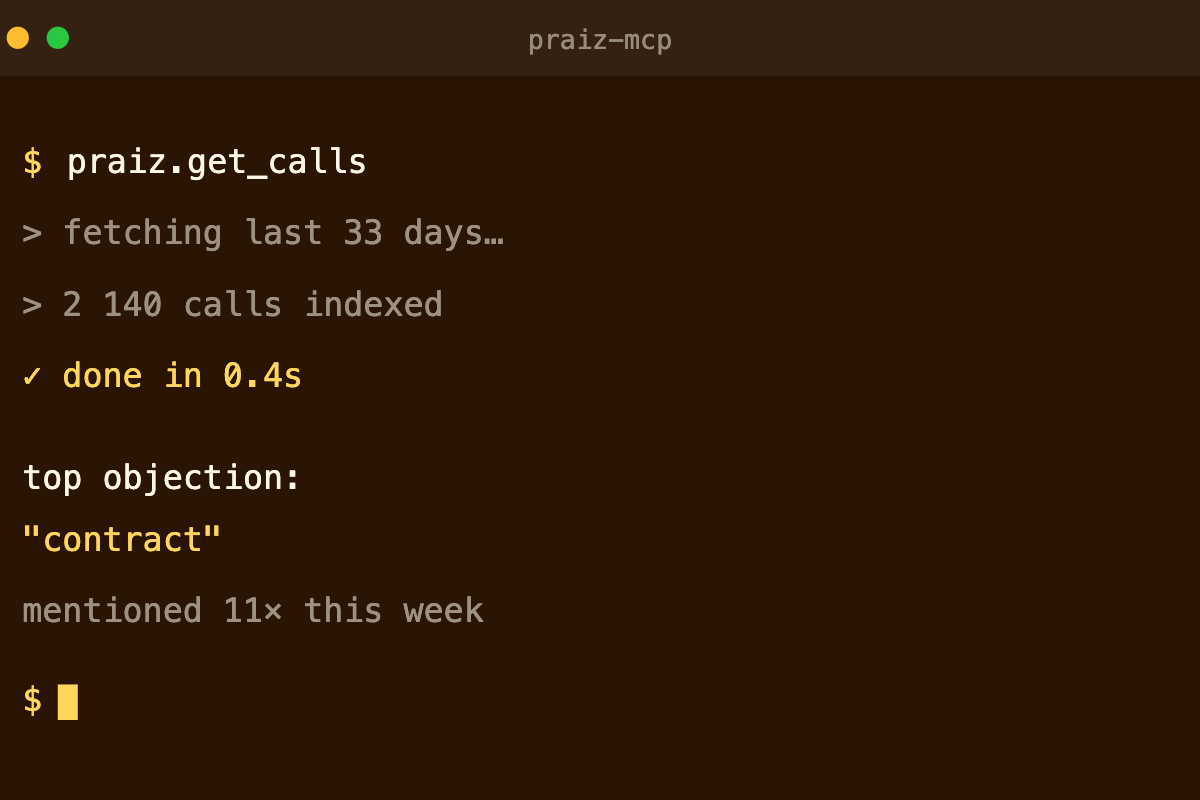
Praiz removes that constraint. AI agents work on every call and meeting, and turn what happened into structured data rather than a recording nobody opens: who attended and in what role, which features were asked about, which objections came up, whether a next step was agreed and when, how much of the call each side spoke.
Three families cover the work: agents that generate the recap and the follow-up, agents that score each demo against your own structure, and agents that track the objections and competitors across all of them. For demos specifically, that means two things a manager cannot get otherwise. Every demo is scored against your five parts, so coaching lands on a specific moment rather than a general impression. And the patterns become visible: the feature that gets asked about in every lost deal, the demos where the economic buyer was never present.
Teams running this measure 100% of calls scored instead of a sample, a 22% improvement on key skills over eight weeks, and a 20% improvement in win rate once the recurring signals are acted on.
You can build a demo scorecard from your own structure, starting from the Praiz AI agents library, and the same grid feeds coaching after the call. The Praiz team configures it with you, which is worth asking any vendor: a scoring grid built on someone else's demo structure measures the wrong things precisely.
See it in action
See what actually happens in your demos
Praiz scores every demo against your own structure and surfaces who attended, what was asked and whether a next step was agreed, without a manager watching an hour of video.
Frequently asked questions
How long should a sales demo be?
Thirty to forty minutes of scheduled time, with the buyer talking about a third of it. The constraint is not the clock, it is the claim: show the shortest path that proves the one thing you said you would prove, then stop.
Demos run long because they try to cover everything. A demo that shows everything proves nothing, because nothing in it was aimed at this buyer.
What should you show in a sales demo?
The shortest route from the problem they described in discovery to the result they want, using their vocabulary and, where possible, their own data.
Cut the company story, the dashboard tour, the admin screens and the integrations list. If a screen does not help verify the claim you stated at the start, it belongs in a later call.
Why do good demos still lose deals?
Most often because the demo was generic, which is a discovery failure rather than a presentation failure. If you do not know which claim matters to this buyer, you show the product in menu order.
The other common reason is the polite demo: everything went smoothly, nobody objected, nobody committed. A demo that produced no friction produced no information.
How do you measure demo performance?
Three numbers: the share of demos ending with a dated next step, the rep's talk ratio, and the share of demos the economic buyer attended.
The third is the one teams avoid and the one that predicts the forecast best. A demo without the person who can sign is a rehearsal.