Praiz scores every call against your sales method and brings together what your prospects and customers say. See what works and what blocks deals, without listening back to calls.

“It allows us to instantly understand key trends from our conversations, without having to analyze it manually.”


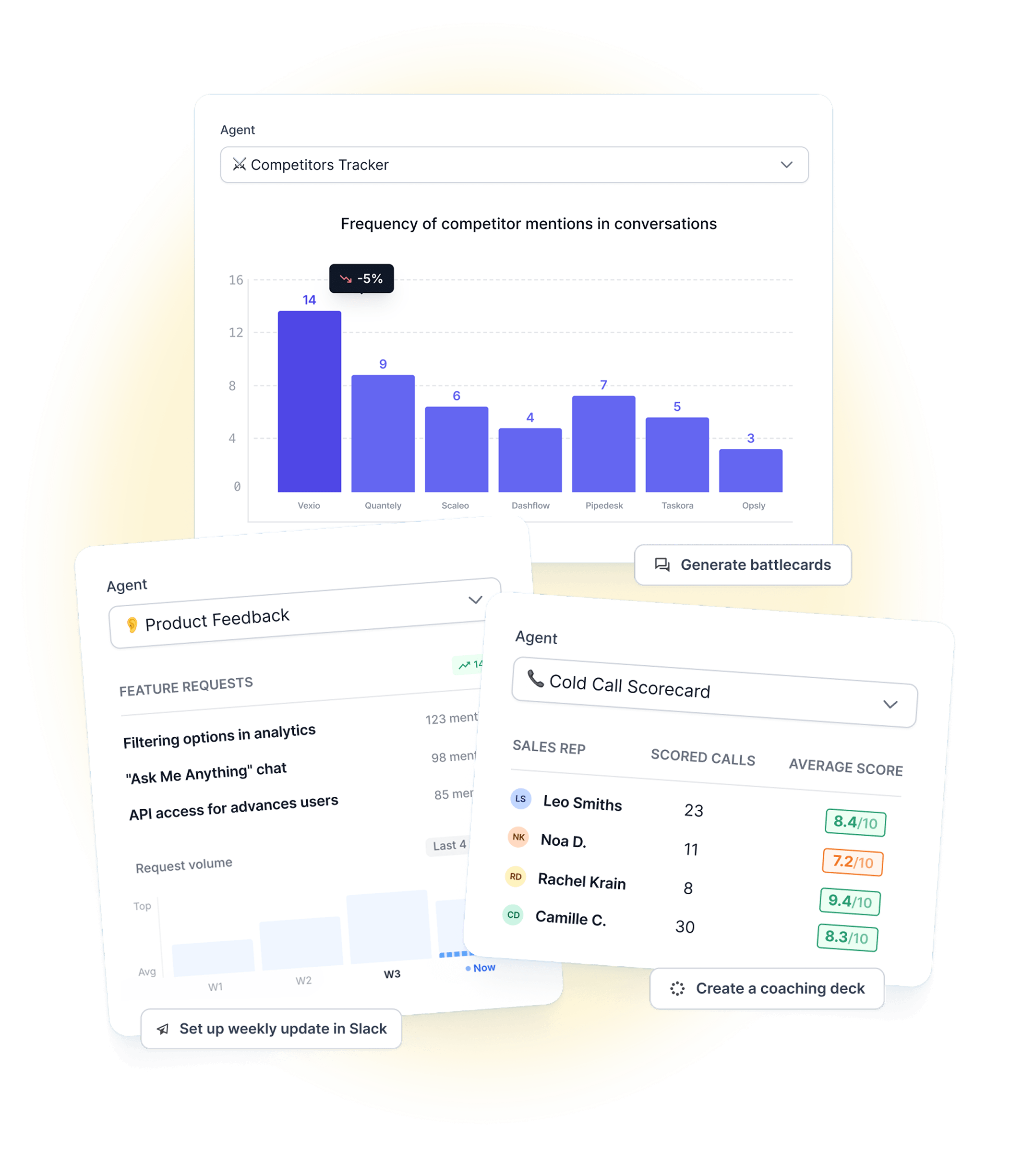
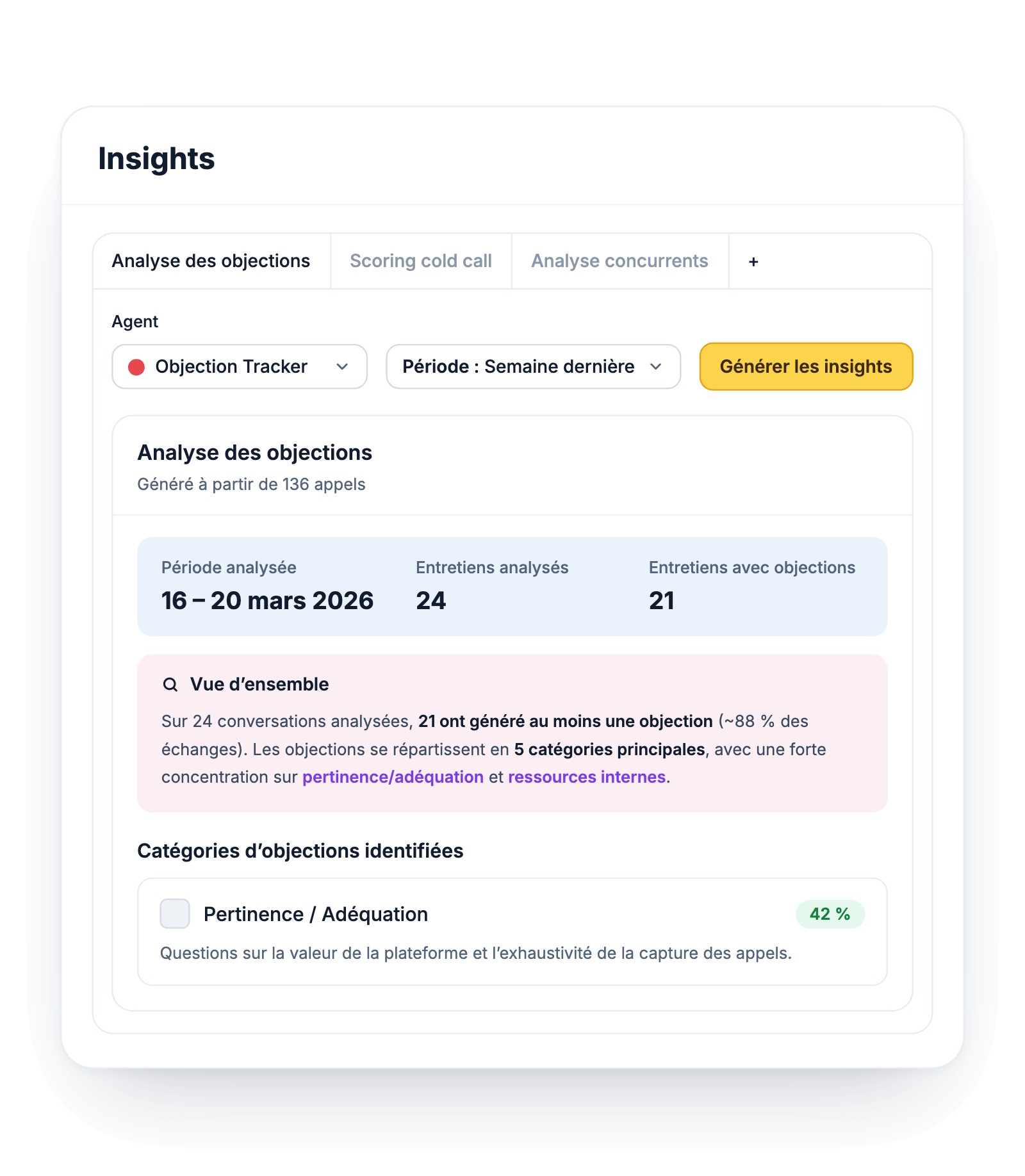
Call analysis turns conversations with prospects and customers into useful information. Praiz records and transcribes every call, then AI agents pull the same information out of each one: objections, competitors mentioned, needs, product feedback, churn signals.
Praiz brings all of it together and writes a report with figures and charts. Filter by period, rep or answer. See which objections come up most, which competitor is showing up more often and where deals stall.
Reports can also go out weekly by email or to Slack.
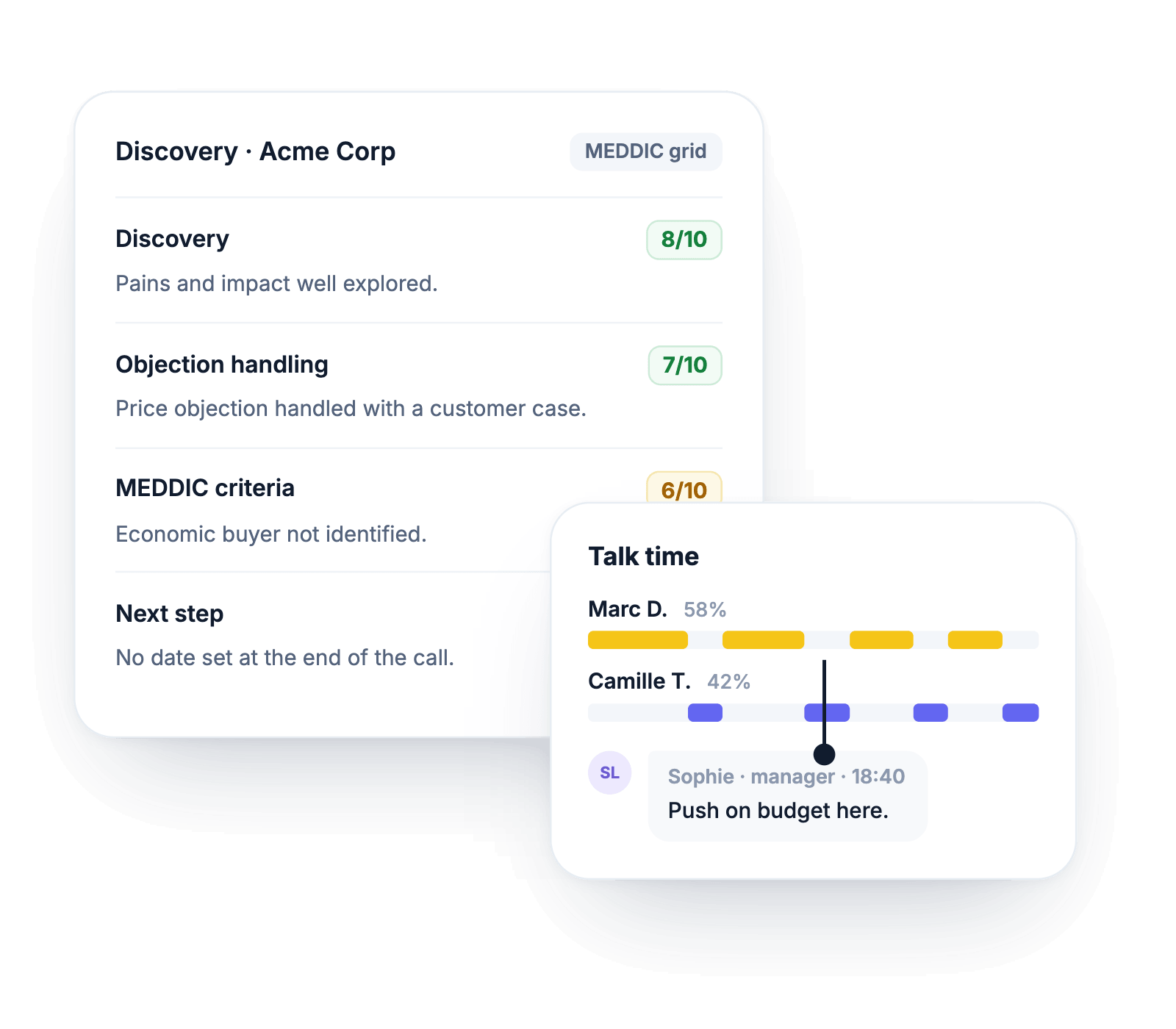
A scoring agent checks the points of your sales method: discovery, objection handling, MEDDIC or SPICED criteria, next step. Each criterion gets a score and a comment.
Managers know which calls to review and what to coach on. They leave comments at a specific moment in the call. Each participant's talk time shows on a timeline.
Evaluates how effectively the salesperson executed a cold call.

Identifies and structures all objections explicitly expressed by prospects or customers during sales conversations.
Captures and structures everything prospects or customers explicitly say about competitors.

Praiz records and transcribes the call, then AI agents read the transcript and fill in the fields you defined: a score, an objection, a competitor, a yes or no. Several agents can analyze the same call, each on its own subject.
Yes. The scoring agent follows your method: internal playbook, MEDDIC, SPICED or your own grid. The Praiz team sets it up with you, then adjusts it from the first results, on your real calls.
On every call, an agent fills in the same fields, and the answer is often a choice from a list you define, so results can be compared from one call to the next. Agents only use what was actually said, and custom vocabulary helps the transcript get your product and competitor names right.
Speech analytics usually refers to contact center analysis: handle time, wait time, compliance, sentiment. Conversation intelligence is the category of tools that turn sales and customer conversations into data, and Praiz belongs to it. Call analysis is its main use: what was said, and what you can do with it next.
A transcript or a summary describes one call in free text, and they can't be compared with each other. Praiz extracts the same information from every call, so you can count, filter and track a trend over time. That's the difference between reading one call and measuring what happens across a hundred.
Zoom, Google Meet and Microsoft Teams meetings, Aircall, Ringover and Minari calls, and in-person meetings recorded with the mobile app. Praiz transcribes 100+ languages, and agents can return their results in a single language whatever was spoken on the call. See all integrations.
Review them in Praiz, send them to your CRM, or query them from Claude or ChatGPT with the MCP server. Automatic delivery, recurring reports and alerts are covered on the post-call automation page.
Calls are analyzed as soon as your tools are connected. For agents configured on your method and tuned on your real calls, plan for about a month of onboarding with the Praiz team.
Recordings and transcripts are stored in France. Praiz does not train models on your data, and the AI providers Praiz uses neither store it nor use it to train their models. Subprocessors and commitments are listed in the Trust Center.
Sales teams for coaching and pipeline, Customer Success for churn signals, product for feature requests. See Sales, Customer Success and Product.
.webp)

