

A cold call script is a structure plus prepared language for the five moments that decide the call. It is not a text to read aloud, and that distinction is why most scripts get abandoned in the second week: a rep reading a paragraph sounds like a rep reading a paragraph, the prospect hears it immediately, and the call is over before the value proposition arrives.
Below: the five moments, a worked example you can adapt, the objections that land in the first thirty seconds, and why the best script available to you is already sitting in your own call recordings.
The bottom line: a cold call script works when it covers the five moments that decide the call and leaves everything between them to the rep. Scripted end to end it gets read aloud, and the prospect hears that within a few words; scripted only where the difficulty actually is, it gets used. Almost all of it happens in the first thirty seconds, and the openers that work on your market are not in a template written for someone else's: they are in your own recordings, said by your own reps on the calls that turned into meetings.
What a cold call script is for
Three jobs, and only the third is about the words.
Removing decisions under pressure. A cold call gives a rep about eight seconds to make a judgment call while adrenaline is up. The script exists so the rep is not inventing a sentence at the moment they can least afford to.
Making calls comparable. If every rep opens differently, you cannot tell whether a low connect-to-meeting rate is the list, the market or the pitch. A shared structure turns calls into something you can measure and improve.
Carrying the language that took a long time to find. The one phrase that makes operations directors lean in took someone six months to stumble on. The script is how that reaches the other nine reps.
What a script is not: a guarantee, a substitute for a decent list, or a replacement for knowing the product. And it does nothing at all if nobody picks up, which is a different problem covered in improving your connect rate.
The five moments a cold call script has to cover
Script these tightly. Leave everything between them to the rep.
1. The opener, which is about earning eight more seconds
The opener's only job is to stop the reflex hang-up. It is not a pitch and it should not contain your company's value proposition.
This is also the one part of the call with real data behind it. Gong analysed a very large call dataset and the spread between openers is wide: their published figures put "Heard the name tossed around?" at a 11.24% success rate and a permission-based opener at 11.18%, against 7.6% for "How's your day going?" and 2.15% for "Did I catch you at a bad time?". The last one is the most common opener in the wild and the weakest in the data, because it hands the prospect a scripted exit.
Take those numbers as directional rather than universal. They come from a different mix of markets than yours, which is the whole argument for measuring your own.
2. The reason for the call, in one sentence
One sentence, naming the problem rather than the product. The test: could a competitor say the same sentence? If yes, it is a category description, not a reason.
Weak: "We help sales teams be more efficient." Better: "I'm calling because most logistics ops teams I speak to are rebuilding next week's shift plan by hand every Friday."
The second one is falsifiable. The prospect can disagree with it, which is exactly what you want, because a disagreement is a conversation.
3. The permission question
A short, explicit ask for thirty seconds. It feels like it costs you something and it does the opposite: it moves the prospect from listening-to-escape to listening-to-decide.
It has to be genuine. If they say no, you take the no and ask for a better time. A rep who asks permission and then talks anyway has trained that prospect never to answer again.
4. The pivot to discovery
The moment the call stops being a monologue. Two prepared questions, no more, chosen so that either answer tells you something.
This is where most scripts are thinnest, and it is the highest-leverage part to prepare properly. There are usable patterns in qualifying questions, narrowed for a cold call: on thirty seconds of attention you get one question, maybe two.
5. The ask
A specific, small, dated next step. "Twenty minutes on Thursday or Friday" rather than "would you be open to learning more".
Two failure modes. Asking for too much, which converts a warm call into a no. And asking for nothing, which is what happens when a rep senses interest and decides to keep talking; the call ends pleasantly with no next step and the deal never existed.
A cold call script to adapt
One worked example, deliberately specific so you can see the mechanics. Alex is an SDR at Fieldware, a fictional company selling shift-scheduling software to operations directors in logistics. Replace every element; keep the shape.
| Moment | What Alex says | Why |
|---|---|---|
| Opener | "Hi Marie, it's Alex from Fieldware. Have you heard of us?" | Short, names himself, invites a one-word answer instead of a hang-up |
| Reason | "I'm calling because most ops directors I speak to are still rebuilding next week's shift plan by hand every Friday afternoon." | Names a specific, falsifiable situation. She can agree or push back |
| Permission | "Can I take thirty seconds to explain why I thought of you, and you tell me if it is off?" | Explicit, bounded, and genuinely offers the exit |
| Discovery | "How are you handling the plan today, spreadsheet or something else? And what happens when someone calls in sick on a Monday?" | Two questions. Both answers are informative, neither can be answered with yes or no |
| Ask | "Worth twenty minutes Thursday morning to see whether this applies to your setup? I'll send an invite now." | Small, dated, with the next action owned by Alex |
Notice what is missing: features, a company origin story, and the word "solution". None of them belong in the first ninety seconds.
If you want more templates to compare shapes with, HubSpot keeps a cold call script template and Salesforce publishes several script variations. Read them for structure, not for the sentences, which were written for other markets.
The objections you will hear in the first thirty seconds
Four, and they are not real objections. They are reflexes, and they need prepared responses rather than argument.
- "I'm not interested." Arriving before you said what it is about, this means "I am not interested in a cold call". One short attempt to name the problem, then a clean exit if it lands flat.
- "Send me an email." Usually a polite end. Accept it, agree what the email will contain, and ask one qualifying question while you have them.
- "We already use X." The most useful thing you will hear. Do not compare products on a cold call; ask what made them choose X and what it does not cover.
- "Now is not a good time." Take it literally, propose a specific alternative, and note it. This one is often true.
None of these is the objection that actually kills the deal. Those come later and they are rarely stated out loud. First-thirty-second reflexes just need to be survived.
Why reps abandon scripts
Four reasons, and they are all design problems rather than discipline problems.
It was written to be read. Full sentences in paragraphs invite recitation. A script that fits on a card, with the five moments and bullet fragments rather than prose, gets internalised instead.
It covers everything. A six-page script is a document, not a tool. Script the five moments and nothing else.
Nobody ever revised it. A script written once and never touched signals that the company does not actually believe in it. Change one line a month, based on what happened on calls.
It came from outside. A script handed down from a consultant, or copied from a blog, does not contain a single sentence that was tested on your market. Reps can tell, and they are right.
Build your script from your own calls, not from a template
Here is the part that most cold calling content skips, because it requires something a template cannot give you.
Somewhere in your recorded calls are the openers that actually got past the first ten seconds with your buyers. Not the openers that work in a Gong dataset or a HubSpot template: the ones that worked on operations directors in logistics in your country at your price point. They are already there, said by your own reps.
The method, and it takes an afternoon:
- Pull twenty connected cold calls. Ten that produced a meeting, ten that did not.
- Transcribe the first thirty seconds of each. Only the first thirty seconds. That is where the difference lives.
- Line up the twenty openers side by side. Patterns appear fast, and they are usually not what the team assumed.
- Write the card from the winners. Use the actual words, not a cleaned-up version of them. The cleaned-up version is how you get back to reciting.
- Test one change at a time for two weeks. One opener, across the whole team, measured on connect-to-meeting. Then the next moment.
Two weeks per variable is slow. It is also the only version where you end up knowing which change did the work, rather than having a new script and a vague sense that things improved.
The constraint is that step two is tedious enough that it rarely happens. Which is the actual reason most teams use someone else's script.
Where Praiz fits in
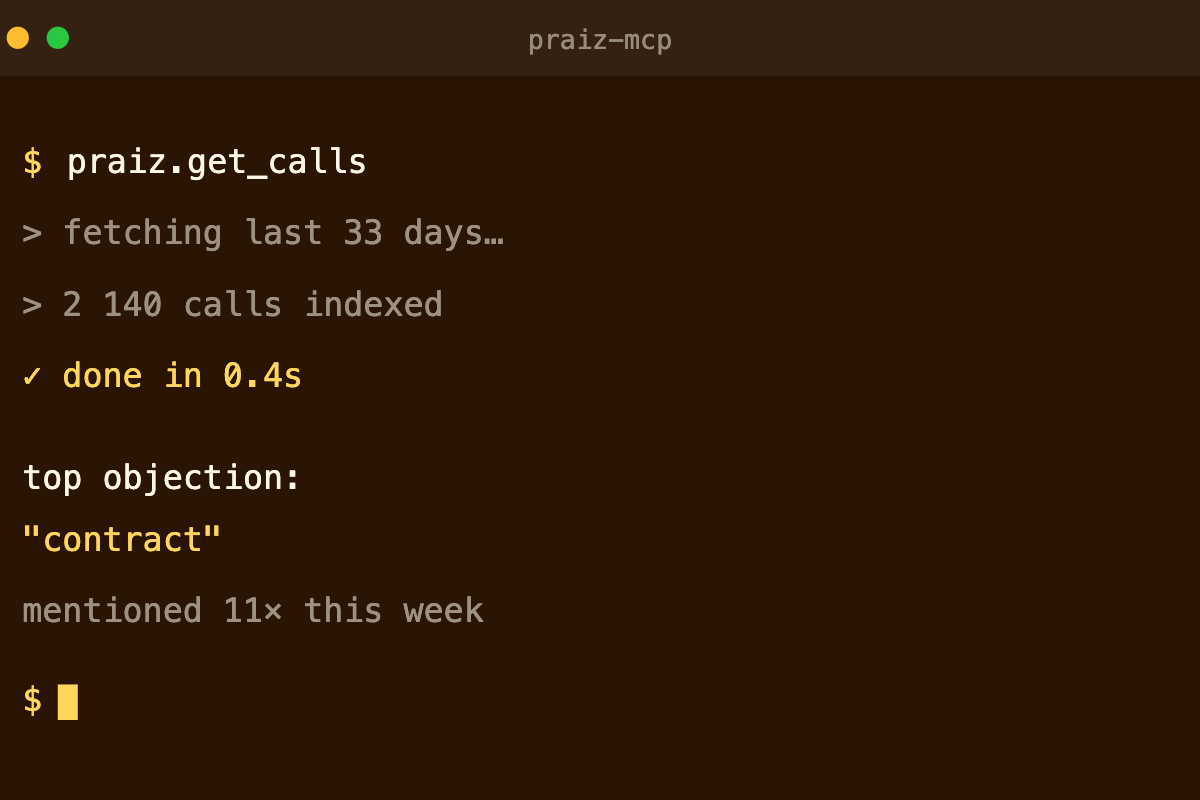
Praiz removes the tedious step. It records and transcribes the calls, including phone calls from Aircall, Ringover, Minari and the HubSpot dialer, and AI agents work on every one of them to turn what was said into structured data: whether the opener got past the reflex, which objection came up, whether a next step was agreed, how the rep handled each moment of the call.
For a script, that changes the exercise from an afternoon of listening into a filter. Every connected call where a meeting was booked. Every call where "we already use X" came up, and which X. Every call where the rep never asked for the next step. The pattern you were going to look for by hand is a query.
It also makes the script enforceable without anyone policing it. A scoring agent can score each cold call against your five moments, which means every rep gets feedback on every call rather than on the two a manager had time to listen to. Teams doing this measure 100% of calls scored and a 22% improvement on key skills over eight weeks, because coaching lands on a specific moment of a specific call instead of on a general impression.
You can start from a cold call scorecard in the Praiz AI agents library or build one against your own script. The Praiz team configures it with you, which is worth asking any vendor about: a scoring grid nobody set up properly produces numbers that look precise and mean nothing.
See it in action
Find the opener that already works on your market
Praiz transcribes and scores every cold call, so you can compare what your reps actually said on the calls that converted and build the script from there.
Frequently asked questions
What should a cold call script include?
Five moments: an opener whose only job is to earn eight more seconds, a one-sentence reason for the call naming a problem rather than a product, an explicit permission question, a pivot to one or two discovery questions, and a small dated ask.
Everything between those five is improvised. A script that covers the whole call gets read aloud, which is the failure mode you are trying to avoid.
What is the best cold call opener?
Gong's published analysis of 300 million calls puts "Heard the name tossed around?" at a 11.24% success rate and a permission-based opener at 11.18%, against 2.15% for "Did I catch you at a bad time?".
Treat that as directional. The spread tells you openers matter enormously; the specific winner for your market has to be found in your own calls, because that dataset is not your buyers.
Should reps read a cold call script word for word?
No. A rep reading sentences is audible within a few words and the prospect disengages immediately.
Write the script as a card: the five moments, with fragments rather than full sentences, in the actual words that worked on real calls. The goal is internalised structure, not recitation.
How do you know if a cold call script is working?
Measure connect-to-meeting rate, and change one variable at a time for two weeks across the whole team.
Changing three things at once gives you a new script and no idea which part helped. Two weeks per variable is slow and it is the only approach that produces knowledge rather than a feeling.